Elf, Dwarf and Goblin Names Compared: What Each Says
Elves flow, dwarves thud, goblins snap. See how sound, structure and family systems separate the classic fantasy peoples, then watch one name get built for each.
A good fantasy name tells you who is speaking before a word of backstory. Elves, dwarves, goblins, gnomes and orcs have each developed a recognizable naming style in games and novels. This article compares them on three axes (sound, structure and family system), summarises the result in a table, and builds one worked example per people. The goal is to help you write names that feel like they belong to a culture, not a random pile of syllables.
Why the differences exist
Fantasy naming mostly borrows from real language habits. Flowing vowels recall Welsh, Finnish or Latin; hard consonant clusters recall Old Norse and Old English; clipped, harsh syllables are an invention to signal "rough". Tolkien, for instance, drew dwarf names from a medieval Norse poem that lists dwarf names, which is why dwarves in many stories sound Nordic. Most later settings follow those habits without copying specifics. Knowing this makes your choices deliberate instead of accidental.
For the underlying method, see how to create fantasy names. This article goes deeper on the peoples themselves.
Elves: long, open and musical
Sound palette: open vowels (a, e, i), liquid consonants (l, r, n, s, th), few harsh stops. Names often end in vowels or soft consonants.
Structure: two to four syllables, often a given name and a descriptive or lineage name. Many settings let the second name be a poetic phrase.
Family and clan: elf societies are often drawn as long-lived, with houses, courts or groves. Names may refer to ancestry, a title or an element of nature.
What it says: age, refinement, a connection to nature or art. A long name signals a long memory. Try the elf name generator to hear the pattern.
Dwarves: short, heavy and rooted
Sound palette: hard consonants (d, k, g, r, b, t), short vowels (o, u, a), consonant clusters. Names tend to close with a consonant.
Structure: one or two syllables for the personal name, plus a clan or craft name. Clan names are often compounds of everyday objects, such as Ironhelm or Deepforge.
Family and clan: clan comes first. Dwarves in most fiction value lineage, honor and craft, so the family name carries weight and is often longer than the personal one.
What it says: stubborn loyalty, tradition, labor. Browse the dwarf name generator for the clan-compound habit in action.
Goblins: quick, scrappy and sticky
Sound palette: sharp, squeaky sounds (k, z, g, sn, sk), repeated syllables, bouncy rhythms. Nicknames and onomatopoeia are common.
Structure: usually one short name, sometimes two with a nickname that describes a habit or injury, like Snik Three-Toes. Rarely any formal family name.
Family and clan: a warren, tribe or boss rather than a lineage. Status comes from usefulness, so names can change as a goblin earns or loses reputation.
What it says: opportunism, humor and survival. The goblin name generator shows how much personality fits into a single squeaky word.
Gnomes and orcs in brief
Gnomes sit between playful and scholarly. In many settings they have long, multi-part names with nicknames and clan titles, bubbly syllables and a love of invention. If you want that pattern, try the gnome name generator. Orcs usually get short, guttural names with strong stops, often a single name plus an earned epithet. The orc name generator covers that style. Both vary widely by setting, so treat them as defaults.
Comparison table
| People | Sounds | Length | Name parts | Social unit |
|---|---|---|---|---|
| Elf | Open vowels, liquids | 3 to 4 syllables | Given name plus lineage or poetic name | House, court or grove |
| Dwarf | Hard stops, short vowels | 1 to 2 syllables | Personal name plus clan compound | Clan and guild |
| Goblin | Sharp, squeaky, repeated | 1 to 2 syllables | Name plus earned nickname | Warren or tribe |
| Gnome | Bouncy, bright | Often long, multi-part | Several names plus clan title | Family and workshop |
| Orc | Guttural, strong stops | 1 to 2 syllables | Name plus epithet | Warband or tribe |
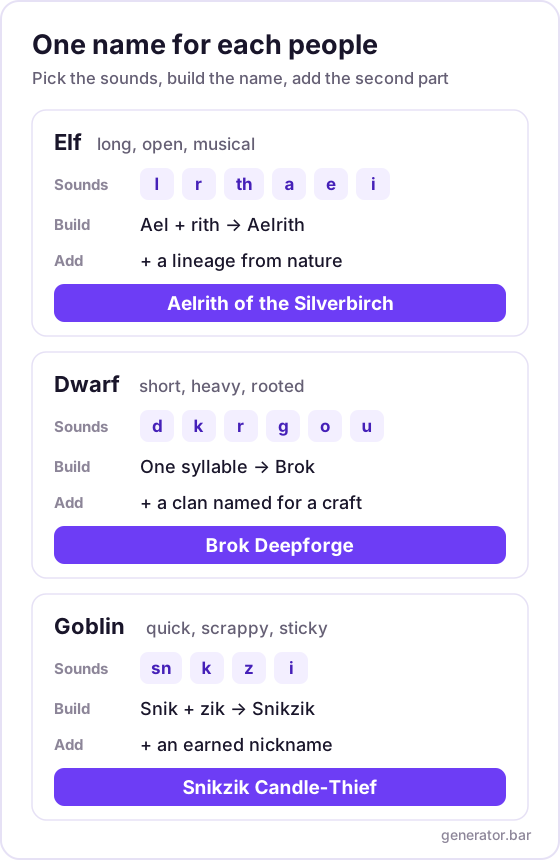
Worked example: one name per people
An elf
- Pick a palette: l, r, th, a, e, i.
- Build two syllables for the given name: Ael + rith, giving Aelrith.
- Add a lineage line drawn from nature: of the Silverbirch.
- Result: Aelrith of the Silverbirch. Meaning could be "dawn-sung, of the silver birch grove".
A dwarf
- Palette: d, k, r, g, o, u.
- Personal name, one syllable plus a closing consonant: Dorgrim or the shorter Brok.
- Clan compound from a craft: Deepforge.
- Result: Brok Deepforge. The clan name tells you the trade.
A goblin
- Palette: sn, k, z, i, with a repeat for bounce.
- Name: Snikzik.
- Earned nickname: an injury, a habit or a success (Candle-Thief).
- Result: Snikzik Candle-Thief. The nickname is the real identity.
If your cast needs more variety inside a single people, the D&D character names guide shows how class, background and region change the pattern.
What a name reveals about the culture
Treat every naming habit as worldbuilding evidence. A few questions turn style into story:
- Who gets a long name? If elves have long names, perhaps names are earned with age, or they preserve a genealogy. A dwarf's long clan name may list ancestors.
- Who can change a name? Goblin nicknames shift with deeds, which suggests a culture where reputation matters more than ancestry.
- What is a name made of? Dwarf clan names drawn from metal and stone say the culture values craft. Elven names drawn from trees and stars say something else entirely.
- Who may use a name? Some settings make true names private, with a public name for outsiders. That single rule creates drama.
- How do outsiders mispronounce it? Translations and nicknames from other peoples show relationships and prejudice. A human who calls Aelrith "Ael" is making a social claim.
Mixing and crossing peoples
Half-elves, orc-raised humans and city-dwelling goblins are where naming gets interesting. A few approaches that keep the result coherent:
- Dual names. The character uses one name at home and another in the wider world, such as a flowing elven given name shortened to a practical nickname.
- Blended patterns. A given name from one culture and a clan or epithet from another show divided loyalties on the page.
- Adopted names. A goblin who joins a dwarf hold might take a short, dwarven-sounding name. The adaptation itself tells the reader something.
Keep the logic simple: decide which part comes from which people, and stay consistent across the cast.
Keeping peoples distinct in one story
- Do not give two peoples the same ending sound. If elves end in -iel, keep that away from everyone else.
- Check how names look on the page together. A cast of five K names is hard to read.
- Let a character break the rule on purpose: an elf with a short blunt name, or a dwarf with a flowing one, hints at a backstory.
- Remember that these patterns are conventions, not laws. Your world can invert them if you do it consistently.