Book Title Formulas That Work for Novels, Essays and Films
Titles follow patterns because patterns tell readers what to expect. Learn the formulas by genre, how to test yours, and how essay and film titles differ.
A title is a very small piece of writing doing a very large job. It has to promise something, fit on a cover or a search result, and still make sense after someone has finished the work. This guide walks through the formulas that recur by genre, what makes a title memorable and findable, how essay titles are different, and a simple way to test your options.
Titles are promises about genre
Readers decode titles in a split second. A title that matches genre conventions tells them where the book belongs; one that breaks them can confuse. Some patterns that recur:
| Genre | Common pattern | Example shape |
|---|---|---|
| Thriller / crime | "The" + noun, or a short ominous phrase | The Last Witness |
| Romance | Emotion, a time, or a pairing | Summer at the Harbor |
| Fantasy | "The [Noun] of [Place/Thing]" | The Crown of Ash |
| Literary fiction | A concrete image or a person's name | The Lighthouse Keeper's Daughter |
| Horror | A place, object or single menacing word | The House on Marrow Lane |
| Cozy mystery | A pun or a craft-and-crime pairing | A Pinch of Poison |
The examples are made up for illustration. The patterns are tendencies, and plenty of successful books ignore them, but you should know when you are breaking one.
Eight reliable title formulas
- The [Person] of [Place]: the Lighthouse Keeper of Saltmarsh.
- Possessive object: the Cartographer's Apprentice.
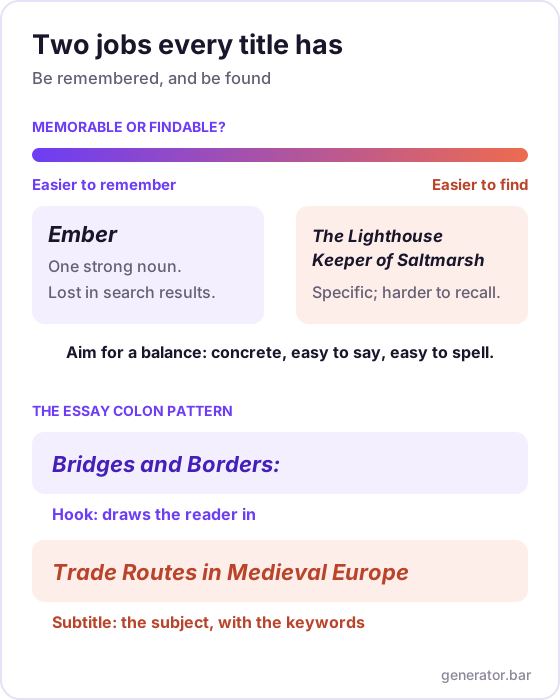
- A single strong noun: Ember. Short, but hard to find in search.
- A name: good for character-led stories.
- A quoted phrase from the text, which gives the title a payoff late in the book.
- A time or date: The Winter of 1962.
- A question: unusual in fiction, common in non-fiction.
- Two contrasting words: Salt and Silk.
If you want fast variations on these, the book title generator produces candidates by genre that you can adapt.
What makes a title memorable and searchable
These two goals sometimes conflict. A single common word is memorable but gets lost in search results. A longer, more specific title is easier to find but harder to recall. Aim for a balance:
- Concrete beats abstract. "The Salt Road" is easier to picture than "The Journey."
- Sound matters. Say it aloud. Alliteration and rhythm help, but too much sounds like a parody.
- Be easy to spell and say, since people recommend books verbally.
- Search it. If page one is dominated by other books with the same title, consider a subtitle or a variation.
- Length: shorter usually fits covers better; subtitles can carry extra keywords for non-fiction.
Working titles and the title you end up with
Almost nobody starts with the final title. A working title is a placeholder so you can talk about the project. Choose one that is useful rather than precious: a plain description of the premise is fine. Revisit it when the draft is done, because you now know what the book is actually about. Often the real title is a phrase, image or line that appeared in the manuscript itself. Search your draft for repeated images before brainstorming from scratch.
Publishers also change titles, so it's worth holding yours loosely if you plan to submit to agents or publishers.
Essay titles and the colon pattern
Essay titles are more functional. In academic and journalistic writing, a very common structure is a catchy hook, a colon, then a descriptive subtitle: "Bridges and Borders: Trade Routes in Medieval Europe." The first half draws the reader in; the second states the subject so a search or a reading list can classify it.
- Put the important keywords in the descriptive half.
- Make the hook relevant. A clever phrase that has nothing to do with the argument will annoy a marker or editor.
- For a class assignment, check the style guide you've been given, since capitalization and format rules vary.
- Don't use a colon if a plain title does the job.
The essay title generator can suggest hook-plus-subtitle structures to adapt to your argument.
Film and screenplay titles
Film titles have to work on a poster, in a listing and out loud. They tend to be short, often two to four words, and they often name a character, place, object or central conflict. Screenplays you are sending out also benefit from a title that tells the reader the genre. For brainstorming, the movie title generator is a quick way to see different tones.
Testing a title
- Say it in a sentence: "I'm reading [title]." Does it sound natural?
- Cover test: picture it in small type on a phone screen.
- Genre test: show it to three readers of the genre and ask what they expect the story to be.
- Search test: look for existing works with the same title.
- Payoff test: does the title gain meaning after the ending?
If you publish under a different name, the same testing applies to the byline. Our guide to choosing a pen name covers that, and the pen name generator can help you brainstorm.
A cautious word on legal points
In many countries a single title is generally not protected by copyright, which is why several books can share the same title. However, a title used across a series or as a brand may be protected as a trademark, and rules differ by country. This is general information only. If your title closely matches a well-known series, brand or product, check carefully or ask a professional.
Even where it's legal, sharing a title with a famous work often hurts discoverability. A distinctive title is both safer and easier to find.
Worked example: retitling a draft
Imagine a novel about a woman who inherits a failing ferry service on a northern lake. The working title is The Ferry Book, which is honest and useless. Searching the draft turns up a repeated image: the ferry's last departure bell. Now try the formulas. "The Last Bell" is short and ominous. "The Ferrywoman's Inheritance" fits the possessive pattern but sounds quiet. "Bells Over Black Water" signals a more atmospheric, suspenseful tone.
None of these is automatically right. Run them through the tests: say each in a sentence, search for clashes, and ask a few readers which one they would pick up in a shop. The best choice is the one that matches both the story and the shelf it will sit on.
Whatever you choose, keep a short list of runners-up. They are useful as chapter titles, series names or subtitles, and sometimes the title you rejected turns out to suit the sequel.
Series titles and subtitles
If your book is the first of a series, think about the series pattern before you finalise the first title. Shared structure, such as the same opening word or a repeated format, helps readers see the books belong together. Non-fiction often adds a subtitle that states the promise outright, which helps both shoppers and search. Fiction usually leaves the subtitle off, but a series line on the cover can do a similar job.