French Names and Their Meanings: First Names, Surnames and Accents
French names follow a few clear patterns: saints' names, compound first names, accents that matter, and surnames that began as a trade, a place or a nickname.
A French name can place a character in a generation, a region and sometimes a family trade before they say a word. The patterns behind French first names and surnames are easy to learn, and knowing them is the difference between a name that sounds French and one that sounds like a guess.
This guide covers where French first names come from, how compound names work, why accents are part of the spelling, what common surnames mean, and how to build a believable French name for a character.
First names: saints, fashion and generations
For a long time, French first names came largely from the calendar of saints. A law of 1803 limited parents to names from saints' calendars and well-known figures of ancient history. It was applied more loosely from the 1960s and repealed in 1993, when parents gained the freedom to choose, with a registrar able to refer an unsuitable choice to a court. That history is why so many traditional French names, such as Pierre, Jean, Marie and Catherine, are saints' names.
Fashion matters as much as tradition. Names rise and fall in waves, so a first name often dates a character:
| Feels like | Examples |
|---|---|
| Grandparents' generation | Michel, Jacques, Marcel, Yvette, Colette, Simone |
| Parents' generation | Thierry, Pascal, Nathalie, Sophie, Isabelle |
| Children and young adults today | Hugo, Louis, Léa, Chloé, Emma, Camille |
These are tendencies, not rules, but a teenage character called Yvette or a grandmother called Léa will make a French reader pause.
Compound first names
Names such as Jean-Pierre, Marie-Claire and Anne-Sophie are single compound first names, joined with a hyphen and used whole. They were especially popular in the middle of the twentieth century. Marie can even appear in a man's name, as in Jean-Marie, because the second element honors a saint rather than marking gender.
Compound names are different from a list of middle names. A French birth certificate can carry several first names, but only the first one, or the compound, is normally used day to day.
Accents are part of the name
French spelling uses accents, and they belong to the name: Hélène, François, Benoît, Océane. The cedilla in François changes the sound of the c, and the accents in Hélène change the vowels. French typography keeps accents on capital letters too, as in Élise and Étienne.
Accents are often dropped online, in usernames and on systems that cannot display them, so you will see Helene or Francois in email addresses. In fiction, though, the accented spelling is the correct one, and readers who know French will notice the difference.
What French surnames mean
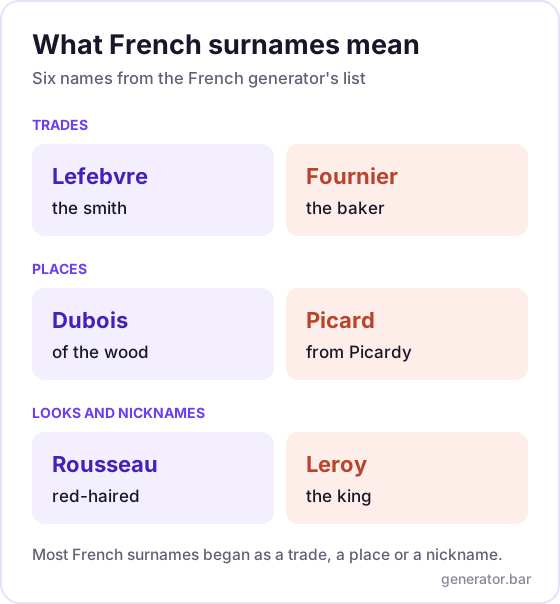
Like most European surnames, French family names were fixed in the Middle Ages and usually described something about the first bearer.
| Origin | Surnames and meanings |
|---|---|
| A trade | Lefebvre (the smith), Fournier (the baker or oven keeper), Mercier (the merchant) |
| A place or landscape | Dubois (of the wood), Fontaine (spring or fountain), Picard (from Picardy) |
| Looks or a nickname | Petit (small), Moreau (dark-haired), Rousseau (red-haired), Leroy (the king) |
| A father's first name | Martin, Bernard, Simon, Laurent, Vincent |
Martin, a name taken from a first name, is widely reported as the most common surname in France. Nicknames like Leroy did not mean the family was royal. They could mark someone who played the king in a festival, worked for a royal household, or simply carried themselves grandly.
Particles: de, du and le
A particle such as de or du in a surname does not prove noble ancestry. Many ordinary families carry names like Dupont ("of the bridge") or Dubois, which began as a description of where someone lived. Particles of nobility exist, but a de alone tells you very little. Le, as in Le Gall or Le Goff, is common in Brittany, where many surnames come from Breton words.
Building a believable French name
- Pick the generation. Choose a first name that fits the character's birth decade, using the table above as a guide.
- Pick the region. Breton surnames often start with Le, Alsace has many German-origin surnames, and the south has its own Occitan forms. A generic surname such as Martin or Bernard fits anywhere.
- Decide on a compound. A compound first name such as Jean-Luc or Marie-Laure suits someone born in the mid-twentieth century.
- Keep the accents. Write the name the way it is spelled in French.
- Say it aloud. French stress falls lightly at the end of a word group, so a name should flow when spoken as one phrase.
The French name generator pairs a male or female first name with a common surname and keeps the accents, so you can draw a few and adjust them with the steps above. To join two results into a compound, take two first names of the same gender: Pierre and Louis become Pierre-Louis. For neighboring traditions, try the Italian, Spanish and German name generators, and for another naming system explained in depth, read Roman names explained.
Sources and further reading
- INSEE, Fichier des prénoms: statistics on first names given in France since 1900.
- Albert Dauzat, Dictionnaire étymologique des noms de famille et prénoms de France: the meanings and origins of French surnames.