How to Choose a Stage Name: Lessons from Performers Who Changed Theirs
Some performers pick a stage name for style. Many are forced to, because someone already has theirs. Here is what their stories teach, and how to test a name before you commit.
When Diane Hall joined the Actors' Equity Association, there was already an actress registered under that name. She took her mother's maiden name instead and became Diane Keaton. Many stage names begin this way: not as a bid for glamour, but as a practical problem that had to be solved quickly.
Whether you are an actor, a musician, a comedian or a drag performer, the problem is much the same. You need a name people can say, spell, find and remember, and you may be using it for decades. This guide covers whether you need a stage name at all, what the unions require, the ways performers really build their names, and the tests to run before you commit.
Do you need a stage name at all?
Often you don't. A guide on stage names from Southern Methodist University's arts entrepreneurship program puts it plainly: most artists keep their own name. A new name earns its place when it solves a specific problem:
- Someone already has your name, either in your union or as a well-known person in your field.
- Your name is hard to say or spell, and people keep getting it wrong in ways that make you hard to find.
- You want some privacy, so that your work and your home life don't share a search result.
- You are playing a persona, as many DJs, wrestlers, drag artists and character comedians do.
- You work in two fields and want to keep them apart.
If none of these apply, your own name is a strong choice. It is already yours and you will always answer to it. Just check first that nobody in your field is using it.
Why many actors had no choice
Performers' unions want every working name to be distinct, so that credits, casting and pay don't get mixed up. Guilds such as SAG-AFTRA in the United States and Equity in the United Kingdom have rules that no two members may share an identical working name, and an actor whose name is taken has to pick another. Some of the best-known names in acting exist because of this rule:
| Born as | Known as | Why they changed | Where the new name came from |
|---|---|---|---|
| Diane Hall | Diane Keaton | Another Diane Hall was registered with Actors' Equity | Her mother's maiden name |
| Joseph Lane | Nathan Lane | A Joseph Lane was already registered with Actors' Equity | Nathan Detroit, a character in Guys and Dolls |
| David McDonald | David Tennant | Another David McDonald was already with the UK union Equity | Neil Tennant of Pet Shop Boys, spotted while looking through Smash Hits magazine |
| Michael Douglas | Michael Keaton | SAG rules, with an actor and a daytime host already using similar names | A phone book, by his own account |
| Emily Stone | Emma Stone | Her name was already in use when she applied for her SAG card | A close variation on her first name |
Michael Keaton's story shows how casual the moment can be. People often assume he chose the name in tribute to Buster Keaton or Diane Keaton, and that explanation still gets repeated. He has said it had nothing to do with either: he looked under K in a phone book, saw Keaton and stopped looking.
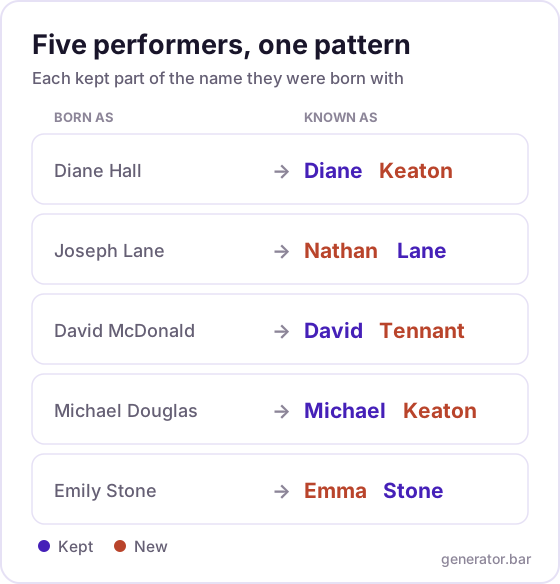
Look closely at that table and a pattern appears: every one of them kept part of the name they were born with. That isn't a rule, but it is good practice. You keep answering to a name you already recognize, and colleagues who knew you before don't have to start from nothing.
Check the current rule. Union rules change and differ by country. SAG-AFTRA, for example, has allowed new members to keep their legal name as a working name even if another member already uses it, provided they sign a waiver. Ask the union directly before you audition or sign anything under a new name.
Five ways to build the name
Keep one half and change the other
This is the simplest method and, as the table shows, the most common. Keep the first name you already turn around for and find a new surname, or keep the surname and adjust the first name. It works especially well for actors, because the result still sounds like a person.
Use a family name
A grandparent's surname, a mother's maiden name or your own middle name gives you something with a real connection to you and a story to tell in interviews. Diane Keaton's name is the classic example. Family names also tend to sound natural because they are real.
Adjust what you have
Sometimes a small change is enough. Andy Warhol dropped the final letter from Warhola. The SMU guide suggests adding a middle initial or adopting an unusual spelling when a notable person shares your name. Be careful with spelling changes, though: a name that looks distinctive on a poster can be hard to find if fans type the usual spelling into a search box.
Borrow from something you love
Nathan Lane took his first name from a musical. David Tennant took his surname from a pop star. Elton John, born Reginald Dwight, built his name from two members of his band Bluesology, Elton Dean and Long John Baldry. A borrowed name comes with a reason you will enjoy explaining, but avoid borrowing so directly that people assume you are related to, or imitating, the original.
Invent a persona
Some acts need a name that belongs to a character rather than a person. Rock singers, DJs, wrestlers and drag performers can go further than an actor usually should, because the name is part of the show. Decide how far the persona goes first. A name built for a loud stage character can be awkward if you later want to do quiet, serious work under it.
Five tests before you commit
- Say it, spell it, remember it. The Actors' Equity Association advises performers to pick a name that is easy to pronounce, spell and remember. To test this, tell the name to someone over the phone and ask them to spell it back to you. Then ask them again the next day.
- Search it. Type it into a search engine, a streaming service and a social platform. If a famous person, a brand or a common phrase fills the first page, you will be competing with them for years.
- Check your union or directory. If you act, check your union and the casting directories in your country, such as Spotlight in the UK, before you print anything.
- Look for matching handles and a domain. You don't need every one, but as the SMU guide notes, the availability of a domain can be a good tiebreaker between two names you like.
- Try it in ten years. Picture the name on a program, on a contract and in an awards announcement. A joke or trend that feels sharp at twenty may feel like a costume you can't take off at forty.
The legal side, briefly
This is general information rather than legal advice, and the rules vary by country.
- A legal change is optional for most performers. Martin Sheen kept his birth name for documents such as his passport. Others made the switch official: Marilyn Monroe's stage name became her legal name in 1956, and David Tennant had legally changed his surname by 2013 to comply with Screen Actors Guild rules. Contracts, tax forms and bank accounts usually need your legal name unless you have changed it, so ask an accountant or lawyer how to set up payment under a professional name.
- A name can work as a brand. The SMU guide calls a stage name your personal brand name. Once you sell music, shows or merchandise under it, trademark law may come into play. The U.S. Patent and Trademark Office explains that a trademark does not give you rights to a word in general, only to how it is used with particular goods or services, and that registered marks have broader protection than unregistered ones.
- Search before you print. Before ordering merchandise or releasing music commercially, search your country's trademark database as well as the web. It is much cheaper to change a name early than after you have an audience.
When you already have credits
Changing your name later is possible, but it splits your record. Reviews, past credits and followers stay attached to the old name, and people searching for you may land on either one. If you are unsure, decide before your first professional credit or commercial release, then use the same spelling everywhere. Consistency does more for a name than cleverness does.
Using the generator
The stage name generator pairs a bold first word with a surname-style word, giving results such as Lyric Frost, Nova Stone or Axel Wilde. Those suit rock, pop, DJ and other persona-led acts as they are. If you are an actor or want something closer to a real person, use the method from the table above: keep your own first name and take only the second word from a result, then run the five tests.
If you are naming more than yourself, read the guide on naming a band, album or podcast or try the album name generator. Writers can use the guide on choosing a pen name, and performers heading for the ring can read about wrestling ring names.
Sources and further reading
- Wikipedia: Stage name, on union rules and the Equity advice on ease of use.
- Wikipedia biographies: Diane Keaton, Nathan Lane, David Tennant, Michael Keaton and Elton John.
- Southern Methodist University, Meadows School of the Arts: Picking a Stage Name.
- U.S. Patent and Trademark Office: What is a trademark?