Wrestling Ring Names: How to Name a Face or a Heel
A ring name has to work in a chant, on a poster and in a promo. Here is how faces and heels are named, and how to build a name for your own wrestler.
A ring name is the first line of a wrestler's story. Before the bell rings, the crowd has already decided whether to cheer or boo, and the name did a lot of that work. It has to be shouted by an announcer, chanted by an arena and printed on a shirt, and it has to fit the character behind it.
This guide covers what separates a hero's name from a villain's, four formulas that ring names are built from, a quick test for whether a crowd can chant it, and how to match a name to a gimmick. It works for a created wrestler in a video game, a fantasy league, a tabletop wrestling game or a character in a story.
Faces and heels: what the name signals
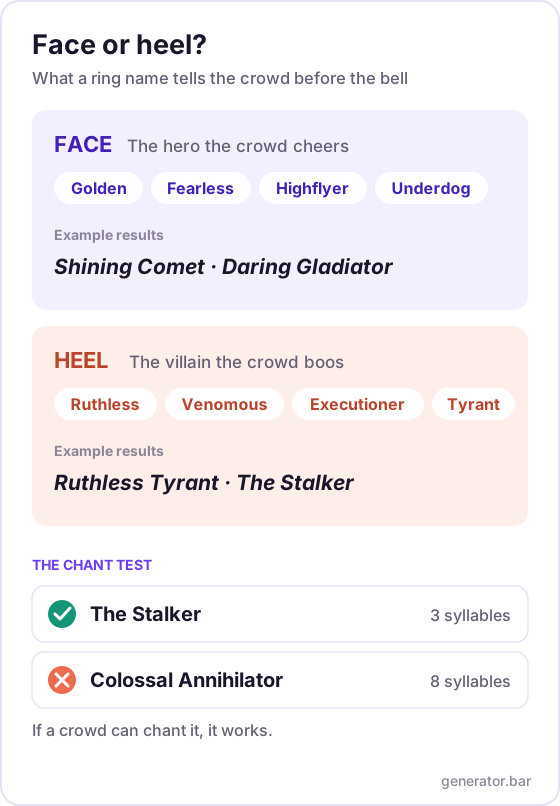
In wrestling, a face (short for babyface) is the hero the crowd is meant to cheer, and a heel is the villain it is meant to boo. Names lean into that role.
- Face names sound bright, open and confident. They promise effort, speed or heart: words like Golden, Fearless, Rising, Highflyer, Comet or Underdog.
- Heel names sound hard, cold or arrogant. They promise pain or superiority: words like Ruthless, Venomous, Executioner, Tyrant or Menace.
Sound helps. Hard consonants such as k, x and z, and heavy endings such as -er and -or, feel aggressive. Open vowels and light syllables feel friendlier. The rule is not absolute, though. A polite, ordinary-sounding name on a vicious character can be more unsettling than another Destroyer, because the contrast makes the audience wonder what is wrong with them.
Four ways ring names are built
Most ring names follow one of a handful of shapes. The examples below are invented for this guide.
| Formula | Example | Suits |
|---|---|---|
| Adjective + noun | Shining Comet, Ruthless Tyrant | Big, simple characters that need no explanation |
| "The" + title | The Underdog, The Stalker | Gimmick-led characters whose role is the whole point |
| A realistic name | Tessa Rowe, Marcus Vale | Grounded, sports-style presentations |
| Name + nickname | Danny "Dynamite" Rowe | Characters who need both a person and a persona |
The first two are pure persona. The third lets the character be a person first, which suits a technical or serious wrestler. The fourth gives you both, and the nickname is often what ends up on the merchandise.
The chant test
Say the name the way a crowd would: loudly, slowly and in rhythm. Short names chant well. The Stalker is three syllables and easy to roar. Colossal Annihilator runs to eight syllables, and no arena will get through it twice.
- Two to four syllables is the comfortable range for a chant.
- A strong first syllable helps an announcer stretch it out.
- Avoid tongue twisters. If you stumble saying it twice in a row, a crowd will too.
If you love a long name, keep it as the full billing and give the character a short form for chants: the announcer says the whole thing once, and the crowd uses the short one.
Match the name to the gimmick
A gimmick is the character a wrestler plays. The name should point at it.
| Gimmick | Words that fit |
|---|---|
| Powerhouse or monster | Titan, Juggernaut, Beast, Monster |
| High-flyer | Comet, Highflyer, Rocket, Flash |
| Technical wrestler | Ace, Prodigy, a realistic first name and surname |
| Underdog | Underdog, Kid, Rising |
| Dark or theatrical villain | Executioner, Phantom, Reaper, Nightmare |
| Arrogant villain | Tyrant, a grand title, or a name used with "The" |
Names that hint at a finishing move work well too. A wrestler called Hurricane or Hammer gives the commentary team something to say when the match ends.
When a face turns heel
Characters switch sides, and the name usually survives the turn. What changes is how it is used: a hero's warm nickname can be dropped, "The" can be added to make the name colder, or the wrestler can insist on a full formal name that nobody used before. Planning a name that can work on both sides saves a rename later.
Practical checks before you commit
- Say it on the microphone. Record yourself announcing the name. If it sounds silly out loud, it will look silly on a poster.
- Check the length. Video game character creators often limit name length, and shirts have limited space.
- Search it. Wrestling companies often trademark ring names. For a game or a story this rarely matters, but search before you print merchandise or perform under the name.
Using the generator
The wrestling name generator has three styles. Mixed leans toward heel and monster names, Face draws only from crowd-pleasing words, and Heel keeps only the villains. Treat a result as raw material: change one word, add a hometown or a catchphrase, and run the chant test. For a performer name outside the ring, try the stage name generator, and for building a convincing antagonist, read the guide on how to name a villain or try the villain name generator.