Dragonborn and Half-Orc Names: How to Name Two D&D Heritages
Dragonborn put the clan first; half-orcs carry two cultures. Here is how to build a name for each, with examples and a quick method you can use at the table.
Some characters can get away with any name. Dragonborn and half-orcs usually cannot, because their names carry a culture with them. A dragonborn introduces the clan before themselves, and a half-orc's name often shows which of two worlds raised them. Get that right and the name does half the work of the backstory.
This guide explains how names work for both heritages in a typical Dungeons & Dragons setting, with a simple method for each and examples you can adapt. As always at the table, your setting and your group come first.
Dragonborn: the clan comes first
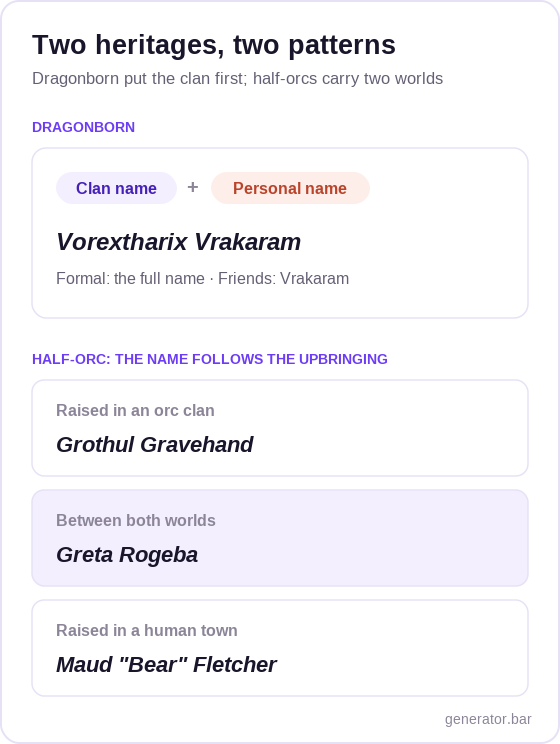
In the common version of the dragonborn, a character gives the clan name before the personal name. The order says something about the culture: the clan's honor matters more than the individual, and a dragonborn who shames the clan shames everyone in it.
- Clan names are long and formal, often three or four syllables, with hard consonants and a sense of age.
- Personal names are shorter, usually two or three syllables, and are what friends use.
- Childhood names appear in many settings too: a blunt, descriptive name a young dragonborn carries until an adult name is earned.
The sound is draconic: hard stops such as k and t, a rolled r, and endings that hiss or growl, such as -ix, -ath or -ulk.
Building a dragonborn name in three steps
- Make the clan name. Join an opening, a short middle and a heavy ending, and say it slowly. Vorextharix, Orthorsendar and Thalirqesh all have the right weight.
- Make the personal name. Keep it to two or three syllables so it can be shouted in a fight: Vrakaram, Keshuna, Orzokar.
- Decide on a short form. If the clan name trips your group every session, agree on a short form such as Vorex, and keep the full version for formal moments.
Put together, Vorextharix Vrakaram is a name you introduce once, formally, and then shorten to Vrakaram for the rest of the campaign. An earned title can come later, after a deed in play gives the character a reason for one.
Half-orcs: a name from each world
Half-orcs often grow up between an orc community and a human one, and the name usually follows where they were raised. Three patterns cover most characters:
| Where they grew up | What the name looks like | Example |
|---|---|---|
| In an orc clan | An orc name, often with a byname the clan gave for a deed or trait | Grothul Gravehand |
| Between both worlds | A human name and an orc name together, in either order | Greta Rogeba, Mokgrim Hale |
| In a human town | A human name, sometimes with a nickname that hints at the orc side | Maud "Bear" Fletcher |
Orc names tend to be short and guttural, built from a hard first syllable and a heavy ending. Human names in a fantasy town sound like farmers, smiths and traders rather than royalty, which makes the contrast with an orc name sharper.
What the name says about the character
The most interesting half-orc names have a story behind them. Ask a few questions:
- Who chose the name? An orc parent and a human parent might each have given one, and the character may use both or reject one.
- Who uses which name? A clan may call them Mokgrim while the town calls them Hale.
- Is there a nickname? A town's nickname for a strong neighbor, such as Bear or Tusk, can be affectionate or cruel, and the character's reaction to it is instant roleplay.
Contrast works well, too. A gentle, bookish half-orc with a blunt orcish name, or a fierce one with a soft human name, tells the table something without a word of exposition.
Table tips for both
- Test it aloud. If the dungeon master stumbles over a name twice, give it a short form.
- Vary first letters across the party. Players remember names by their first sound, so two characters starting with the same letter cause mix-ups.
- Leave room to grow. Bynames, titles and new nicknames are rewards that the story can hand out later.
Using the generators
The dragonborn name generator gives a clan name and a personal name in that order, with male, female and personal-name-only options. The half-orc name generator has the three upbringings above as styles: Mixed heritage, Orc-raised and Human-raised. For a pure orc name, use the orc name generator, and for other tabletop peoples, try the tiefling name generator. The guide to D&D character names covers matching a name to class and background, and elf, dwarf and goblin names compared shows how other peoples differ.
Sources and further reading
- Dungeons & Dragons Player's Handbook (Wizards of the Coast): heritage descriptions, including naming customs for dragonborn and half-orcs.