Funny Names: What Makes Them Work and How to Invent Your Own
Why is Admiral Bogglethorp funnier than Admiral Smith? Researchers have actually studied what makes words funny. Here is what they found, and five ways to use it when you invent a name.
Admiral Smith is an officer. Admiral Bogglethorp is a joke, and you knew that before anything happened to him. Nothing about the rank changed. One surname simply sounds wrong for it, and most people feel that immediately without being able to say why.
That reaction is less mysterious than it seems. Psychologists have measured which words people find funny, and comedy writers have been using the same effects for centuries. This guide covers what the research found, five methods for building a funny name, how to match a name to where you will use it, and where funny names tend to go wrong.
What research says about funny words
Rare words are funnier than common ones
In a study published in Behavior Research Methods, Tomas Engelthaler and Thomas Hills asked 821 people to rate how funny English words were, on a scale from 1 to 5. They collected ratings for 4,997 words. Most words aren't very funny: the average score was just 2.41.
The top of the list was mostly mildly rude words, which won't surprise anyone who has met a twelve-year-old. Just behind them came more innocent entries, including nitwit, twit, waddle, tinkle, bebop, egghead and twerp.
The useful finding for name inventors is what predicted those scores. The strongest link was with how often a word is used: less common words were rated funnier. Word length had almost no effect. So a long name isn't funnier just for being long, and a rare word has a head start over a common one.
People agree on some words and not others
Men and women gave the same average score overall, but they differed on individual words. Women rated giggle and circus well above how men rated them, for example. Younger participants found goatee funnier than older ones did, while older participants scored jingle and pixie higher. Still, some funny words had broad agreement across men and women, including chug, fluff, jabber, tinker and prance. If you are writing for a mixed crowd, those are good raw material.
Meaning matters too. The least funny words in the study included torture, gunshot, death and war. A word's sound can't rescue a grim meaning, which is worth remembering if you plan to give a comic character a dark surname.
Made-up words can be funny because of their spelling
Another team, led by Chris Westbury at the University of Alberta, looked at invented words. The project grew out of earlier research in which participants would laugh at some non-words, such as snunkoople. The researchers linked funniness to how improbable a word's letter pattern is, which they measured using a statistic called entropy. A non-word like finglam, with unusual letter combinations, was predicted to be funnier than clester, whose letters fall into a more familiar pattern. When people chose the funnier of two non-words, the bigger the difference in entropy, the more likely they were to choose as predicted.
The researchers pointed out that Dr. Seuss had got there first. His invented words, such as yuzz-a-ma-tuzz, use the same improbable letters, including plenty of z's.
The Alberta team also connected this to an older idea, going back to the philosopher Arthur Schopenhauer: we laugh when something violates our expectations. That explains Admiral Bogglethorp. The rank sets up an expectation, and the surname breaks it.
Five ways to invent a funny name
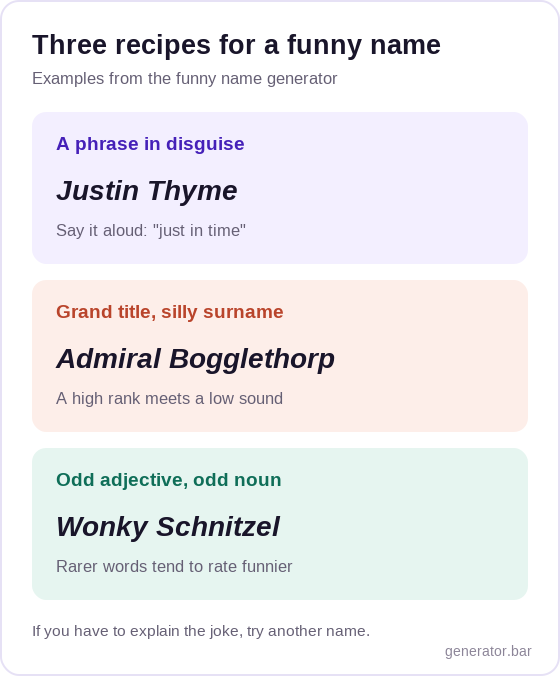
1. Hide a phrase inside a name
Say Justin Thyme or Pat Pending aloud and you hear something else. There is even a word for accidental versions of this. In 1954 the writer Sylvia Wright described how, as a child, she heard the ballad line "laid him on the green" as "Lady Mondegreen", and such mishearings have been called mondegreens ever since. A pun name is a mondegreen on purpose.
To write one, start with a first name that is also the start of a common word or phrase, then split the phrase to fit. The results below are old jokes rather than new inventions, but they show the method:
| Start with | The phrase | The name |
|---|---|---|
| Barb | barbed wire | Barb Dwyer |
| Sue | soufflé | Sue Flay |
| Will | willpower | Will Power |
| Terry | terrible | Terry Bull |
2. Pair a grand title with a silly surname
This is the Bogglethorp method. Put the highest rank you can next to the lowest-sounding surname you can find: Emperor Honkington, Countess Crumblebun, Doctor Wobbleknees. It is reliably funny because the title makes a promise that the surname breaks.
3. Turn a funny word into a fake family name
Take one of the words people agree is funny and add an ending that sounds aristocratic or English, such as -ton, -worth, -wick or -bottom. From the research above, you get Fluffington, Chugworth, Prancewick and Jabberton. The ending makes it sound like a real family that has been ridiculous for generations.
4. Combine two unexpected words
An adjective and a noun that don't belong together make an easy name for a pet, a mascot or a team: Wonky Schnitzel, Grumpy Nugget, Bonkers Parsnip. Choose the less common word when you can, in line with the finding above. A rutabaga is simply a more amusing vegetable than a carrot.
5. Make the name suit the job, or badly fail to
A name that happens to fit its owner is called an aptronym. Real examples include Sara Blizzard, a BBC weather presenter, and the sprinter Usain Bolt. The opposite has a name as well: columnist Gene Weingarten coined inaptonym, and Rob Banks, a police officer, is a fine example. Writers do this on purpose, as when Charles Dickens named a tyrannical schoolmaster Mr. Gradgrind. Try it with your own characters: a dentist called Dr. Yank, or a lifeguard called Sinker.
Match the name to where it will be used
| Where it's going | Best method | Why |
|---|---|---|
| Trivia team or a spoken roll call | Hidden phrase | Someone reads it aloud, which is where the joke lands |
| A novel or short story | Grand title or fake family name | Puns often fail in print, where the spelling gives them away or hides them |
| Tabletop character | Fake family name | It is fun to say, and it still works after the twentieth repetition |
| Pet or mascot | Two unexpected words | Easy to shorten: Wonky Schnitzel soon becomes Schnitzel |
| Comic villain | Grand title | The pompous rank suits the character, and the surname deflates it |
| Username | Two unexpected words | Short, typeable and often still available; see our gamertag guide |
Where funny names go wrong
- The joke has a target. A name should be funny in itself. Don't use names to mock a real person, or treat a language or culture as the punchline by inventing foreign-sounding gibberish. That kind of joke only works for the person telling it.
- It reads as something rude when spoken. Pun names can hide phrases you didn't intend. Say the name aloud, ideally to someone else, before you print it on a shirt or read it to a room of children.
- There are two jokes in one name. Flappy Wobble repeats itself, because both words do the same job. A funny word usually works better next to a plain or grand one, which gives it something to play against.
- It needs explaining. If you have to say "because it sounds like...", the name has already failed.
- It breaks the tone of a serious story. A comic surname on a character the reader is meant to fear can undercut every scene they appear in, unless that contrast is the point.
Using the generator
The funny name generator uses three of these methods: hidden-phrase names, grand titles with silly surnames, and pairs of unexpected words. To improve a result, keep its structure and change one word to something rarer or more specific. You could also raise the rank in a title name, since Admiral can always become Grand Admiral.
Comic villains get more depth in the guide on how to name a villain, and tabletop players can pair this with the D&D character names guide or the gnome name generator, since gnomes are often played for laughs. For animals, the pet name generator has plenty of food names to build on.
Sources and further reading
- Engelthaler, T. and Hills, T. T. (2018). Humor norms for 4,997 English words. Behavior Research Methods, 50(3), 1116–1124.
- Westbury, C., Shaoul, C., Moroschan, G. and Ramscar, M. (2016). Telling the world's least funny jokes: On the quantification of humor as entropy. Journal of Memory and Language, 86, 141. Summarized by the University of Alberta in The snunkoople effect.
- Wikipedia: Aptronym, Nominative determinism and Mondegreen.